While reading Javier Marías' three-part Your Face Tomorrow, I didn't realize that the main character/narrator had appeared in some of the author's earlier works. When I came across that piece of information, reading some of the YFT discussions at Conversational Reading, I went out, bought and read All Souls, where (as far as I know) Marías originated his Oxonian Madrileño character, Jacques/Jaime/Jacobo Deza. Even though the action of All Souls takes place some years before the plot of Your Face Tomorrow begins, reading the first novel second enhanced my appreciation of both books and my understanding of Marías' style and thematic preoccupations. There are many parallels and resonances between the books - both have key scenes involving the main character following/observing someone in a museum, and both build up to the story of a suicide. Besides these parallel features, there are also many "callbacks" from All Souls in YFT - characters, stories, quotations, ideas - a theory of horror illustrated by a gypsy flower seller and a three-legged dog, to name one of the most memorable.
It doesn't seem as if Marías planned for All Souls to be the first in any kind of series of books featuring the character Deza (in fact, he isn't even named in All Souls, perhaps deliberately tempting the reader - despite a warning at the front of the book - to identify him with the author). In YFT, it seems that Marías had to find a way of bringing a character that he killed off in All Souls back to life because he wanted to write more about him. The solution, inventing a surviving brother with very similar life experiences, may seem contrived but it's hard to imagine how YFT could have existed without Marías solving this problem in some way, so central is this character (Rylands/Wheeler, revealed at the end of YFT to have been based on a real Oxford mentor figure of the author's) to the story. Apparently, there are other Marías novels with shared characters, including the follow-up/sequel to All Souls, Dark Back of Time, which I plan to read soon. Brief, brilliant, and surely one of the greatest "campus novels" (though it transcends that genre) outside of Lucky Jim, I can recommend All Souls without reservation to be read as an introduction to Marías or as a warm-up for or follow-up to Your Face Tomorrow.
Friday, April 22, 2011

Tuesday, April 12, 2011
A Job I Am Glad I Do Not Have
Much as I enjoy baseball and, in particular, Cardinals baseball, I really really would not want to be a baseball beat reporter. Here's one reason why. If, like me, you find it too painful to sit through the entirety of this video, just skip to about the last thirty seconds. The look on the guy's face at the very end is priceless.
And on a related note:
"...what LaRussa has on other pantheon managers is that he's the only one whose car keys Buzz Bissinger has tried to take after a scotch-y night at a Macaroni Grill in suburban Houston."
Also, for the record, I respect LaRussa's accomplishments, generally approve of his managerial style, and admire the good work he does for animals. Don't want to be lumped in with the LaRussa haters, of which there are plenty.
Noise & Silence
Earlier this month, I took a free tour of Columbia's Computer Music Center (formerly the Princeton-Columbia Electronic Music Center), the highlight of which was getting to see this beast, the historic and currently non-functioning RCA Mark II synthesizer. In looking up that last link, I noticed that this bit of (presumably) fake trivia has been inserted into the RCA's Wikipedia page: "Igor Stravinsky was rumored to have suffered a heart attack upon hearing Babbitt's glowing description of the synthesizer's capabilities".
The tour (part of the Unsound Festival) having whetted my appetite for synth/computer music, I went down to Littlefield in the Gowanus this weekend to check out Marcus Schmickler's set. I mentioned in this post that I was enjoying some of Schmickler's recent computer-generated sounds. His set was considerably more punishing than I expected from hearing his arpeggio-crazy album Palace of Marvels (the description of which cites, among many other things, Leibniz, Foucault, and the Panopticon!), but then again, the title of the showcase was "Oceans of Noise". I was thinking up titles for sections of Schmickler's set as it was going on, but only got as far as these first two, "Chorale for Jet Engines" and "Colecovision Nightmare".
Schmickler deployed an impressive variety of sounds in his multi-pronged digital noise attack, all of which gave me a new context in which to appreciate the wholly analog, truly assaultive, and I would guess unsynthesizable noise that the boiler pump in my basement started making later than same night. If I'd had a sampler handy, I certainly would've captured the sound for future use.
As an antidote to all this noise, I listened to what must be very close to the opposite pole of music, and very near to silence in comparison, John Cage's music for prepared piano. The Cage, two discs on Naxos featuring the pianist Boris Berman, was part of a big The Rest Is Noise-inspired purchase I made at J&R Music World, a surprisingly good source for bargain-priced jazz and classical CDs (they even carry this rather amazing item), and one of the few remaining venues (after the demise of the NYC Virgin Megastores and Tower Records) where one can have the experience of browsing thousands of discs on multiple floors under harsh fluorescent lighting. There's a nicely melancholy tribute to departed record stores and the joy of the browse here.
And speaking of the browse, there were some unusually worthy finds in the "dollar room" at the Brooklyn Record Riot this weekend. In particular, there was one box of mostly '80s stuff from which I extracted seemingly good condition (haven't played them yet) records by Squeeze, the Del-Lords, Ian Hunter, Dave Edmunds and Nick Lowe! (I also paid more than a dollar for records by Andrew Hill and the Young Fresh Fellows.)
Tuesday, March 29, 2011
Five Music-Related Items
1
Ives playing Ives - a decidedly lo-fi recording, but Ives brings a certain I-don't-know-what to his own composition ("The Alcotts" section of the Concord Sonata) that isn't present in any other version I've heard.
2
Speaking of 20th-century composers, if I ever become a full-time aesthete, haunting avant-garde salons and whatnot, I plan to adopt this look. Hearing this Boulez recording of Ionisation recently made me wonder if Brian Wilson was listening to Varèse around the time of Pet Sounds and the original Smile sessions. To me, there are some clear similarities - the layering of different percussion instruments and, of course, the use of fire sirens and (though not in Ionisation) theremins. I think there's something about the reverby room sound on the Boulez version that makes me think of the sounds Wilson was getting at Gold Star and Western Recorders. In other versions of Ionisation, I don't hear the connection as much. The Varèse-Zappa connection has been well documented (and the Varèse-Bird connection!), but, perhaps unsurprisingly, I've never heard Varèse mentioned in the same sentence as the Beach Boys.
3
Any list of the greatest guitar riffs of all time that does not include some version of Johnny Kidd & The Pirates' "Shakin' All Over" is not to be taken seriously. Check out Jimmy Page trying to remember it here.
4
Last week, I saw a screening of Glenn Ligon's film The Death of Tom at the Whitney, attracted by the prospect of hearing the score performed (actually spontaneously re-composed) by Jason Moran. The film and Moran's performance were worth walking through a hail storm for, and I got a lot out of the discussion after the screening. The topics included Ligon and Moran's mutual love of Monk; Ligon's artistic decision to let his original conception of the film go and yield to the opportunities afforded by an epic camera/film stock fail and Moran's music, ending up with a very different film than he'd envisioned; and Moran and the Bandwagon's ongoing process of wrestling with Bert Williams' massive-for-its-time hit "Nobody" (a hidden track on Ten and a main motif in Moran's Death of Tom music), with renditions often breaking into violent deconstruction and stopping just short of total destruction. There's a good interview of Ligon, conducted by Moran and covering some of the same topics as the Whitney discussion, here.
5
I recently found a great anecdote from the history of architecture that says something about the 20th-century tendency toward refinement (in the sense of removing impurities, extraneous elements) in design (although both of the architects in question were often less restrained in practice than the anecdote may suggest). To tangentially relate this last item to music, I'll note that it comes via the website of Ken Vandermark, the great Chicago saxophonist who I saw recently with Joe Morris and a couple years ago with Jason Moran.
Friday, March 18, 2011
Chelsea USA
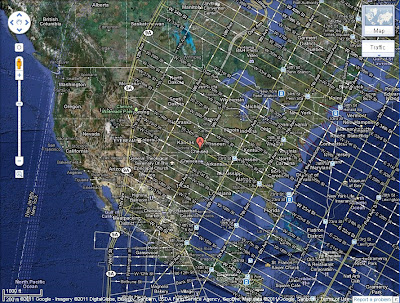
Google Maps has been acting up lately, at least for me. One result was this map, improbably superimposing Chelsea over the entire United States, creating a fun alternate reality in which the Hotel Gansevoort is located on the outskirts of Guadalajara:

Thursday, March 17, 2011
Your Face Tomorrow
I finished the final volume of Javier Marías' Your Face Tomorrow over the weekend. I'm definitely not done thinking about it, but I might venture a few tentative thoughts.
The structure of this three-volume,1200+ page work is one of the most intriguing things about it. I'd like to see somebody chart the plot of YFT, to show how frequently the action jumps backward in time only to return to the main story, the whole of which is being related after the fact by the narrator/protagonist. [The chart probably wouldn't need to be as complicated and this or this. Maybe it would look something like this.] This narrator, Jacques Deza, comments several times on how a few of the main characters, himself included, share the ability to never "lose the thread", no matter how many tangents they follow or parentheses they insert into a conversation. And this is exactly what Marías does. Although the timeline of the main story may only advance by a matter of minutes in hundreds of pages, as happens in the second volume, Marías/Deza never lets go of the thread, always finding his way back from the innumerable digressions, asides, speculations, backfills, and recollections within recollections. In retrospect, it becomes clear that the digressions are really just as much part of the story, just as important, as the main thread. Though the material is much different, the way that stories lead to other stories, or memories to other memories, in YFT is not unlike the book-within-a-book in Michal Ajvaz's The Golden Age (which I discussed here), with the key difference that Ajvaz's narrator does lose the thread as he's pulled deeper and deeper into "the Book".
The pace of YFT's main story seems to pick up a bit in the third (and longest) volume, as Marías starts to pay off on a lot of things he'd set up much earlier - hints, allusions, questions, obsessively repeated words or quotations of initially unclear import. Still, the bare facts of the plot could have been related in conventional novelistic fashion in a matter of a few hundred pages, even taken at a leisurely pace, pausing frequently to describe rooms and sunsets. So what does Marías need three volumes for? I wouldn't call YFT an experimental novel. Structurally, Marías is not doing anything more radical than Proust (and certainly less radical than Sterne). He does, however, find a way of representing his narrator's consciousness, his internal monologue, that may not be new but certainly is distinctive and effective. The voice and storytelling method Marías has fashioned is even, to indulge in a book jacket blurb cliche, compulsively readable despite the sheer length that results from this approach. If you can get on Marías' wavelength in the first book, you'll be with him for the long haul, all the way to the end of his epic London-Madrid sort-of-spy story.
With YFT, Marías makes a case for the novel's continued relevance as a form uniquely suited to shed light on the mysteries of human consciousness and human behavior. I'm pretty sure he's also given us some deep insights on the perennial (and interrelated) subjects of history, memory, war, and violence, but these (especially the last two) are the aspects of the book that I feel I'm still unpacking, and writing about them would probably merit a whole separate (and much longer) post.
[After finishing this post, I've started working my way through the series on YFT at Conversational Reading, which I'd specifically avoided - along with almost all reviews - until I finished the book.]
Monday, March 7, 2011
Soul In The Night & Other Finds
Perhaps the most interesting find on my most recent visit to the Jazz Record Center was a mid-sixties Sonny Stitt-Bunky Green session called Soul In The Night (with future Earth, Wind & Fire leader Maurice White on drums!). While this album is squarely in the soul jazz/organ jazz tradition, from an era when presumably these tunes might've shown up on Chicago jukeboxes, Bunky Green's eventually quite influential (on Greg Osby, Steve Coleman, and Rudresh Manhanthappa, among others) approach on alto is very much in evidence, and the pleasing contrast with Stitt brings it into sharp relief. While some of the tunes seem a bit dated in their Swinging Sixties-ness (at certain points, you can almost picture Austin Powers doing The Frug), there's some real meat here, as on the Stitt-composed simple blues blowing vehicle "Home Stretch", where the two altos stake out their respective aesthetic positions with some nice trading.
Green was still playing "inside" by almost any definition, but with a slight kink or skew away from the mainstream and the alto tradition represented at that time by Stitt, the great Bird torch carrier.
It might be a stretch to call Soul In The Night a template for the Green-Manhanthappa dual alto disc Apex, but I think it would certainly make for an interesting back-to-back listen, and there is a nice bookend quality, with Green having been the young up-and-comer on Soul In The Night and the respected elder on Apex. [When I started writing this, I had no idea that this fantastic Manhanthappa on Green post was going up at Destination: Out.]
In the Record Center's "bargain bin", where surprising treasures lurk, I found the legendary-in-certain-circles Furry Lewis Fourth & Beale, recorded by the also legendary-in-certain-circles Memphis producer Terry Manning with the artist sitting in bed with his wooden leg off. There's a newer version out there with more tracks than this disc has, but for $5 I can't complain - I'd probably pay five bucks for a blank disc if it had Stanley Booth liner notes. I also picked up an album of Kurt Weill songs by Tethered Moon, the trio of Masabumi Kikuchi, Paul Motian and Gary Peacock, the first two of which will be at the Village Vanguard this week.
Subscribe to:
Posts (Atom)