I think it's important (and, more importantly, fun) to supplement one's live music diet by occasionally taking a chance on a show, going to something based on just a name or a description without having heard any of the music or knowing about any of the musicians. If you're open to avant-garde/experimental music, The Stone is a good place to indulge in this kind of experiment. Which is how I found myself attending something called "The Quarktett Presents: The Destruction of Black Civilization".
Conceived by writer/critic Greg Tate, this was ostensibly a celebration of historian Chancellor Williams that, through a series of improvised "movements", took the form of a necessarily incomplete, but still impressive, grand tour of Black Music from blues and gospel to the funky electric church of Miles. I'm not sure I got an accurate count, but there were something like 14 musicians on stage (including a reader, a singer, and Tate doubling on laptop and bass). It is a measure both of my ignorance and of the current depth of talent in New York City that I was not previously aware of any of these musicians (save Tate, and I didn't know he played bass).
While Tate's ensemble Burnt Sugar (many of whose members were part of the Quarktett) relies on a system of "conduction" to guide their improvisations, this evening of music was guided by instructions, written by Tate and read to the players before each of the movements. Though not all of the 16 movements were performed due to time constraints, they were an eclectic bunch and the instructions reflected Tate's sense of humor and willingness to both challenge his musicians and allow them quite a bit of freedom.
Having only read about them, I imagine that this is what the musical/theatrical pageant/happenings of the late '60s and early '70s, as organized by groups such as the AACM, BAG, and the Human Arts Group, might have been like, incorporating poetry, theatrics, education, with improvisational music (in a pre-planned framework) at the heart of the enterprise.
The content of the music in some movements was left entirely up to the players and their interpretations of the instructions. In others, they were playing along with tracks or samples from Tate's laptop. Though many styles were touched on, the band was obviously at home in an electric Miles groove (apparently a major component of Burnt Sugar's sound), as they proved during a movement that consisted of playing "Directions" over a processed/distorted playback of one of Miles' groups playing it - bassist Jason DiMatteo particularly stood out on this one with some full-on, fast and furious Dave Holland stuff.
The evening ended on a very high note with a final movement utilizing Burnt Sugar's conduction techniques - trumpeter Lewis "Flip" Barnes' highly animated conduction of the group closed out the movement, beginning with instructions to the keyboardists to "play some Cecil", gradually building and cohering into a joyous, full group blues, provoking spontaneous vocalizations from a very amped audience.
Thursday, January 28, 2010

Wednesday, January 27, 2010
Notes From The West Coast, Part Three - Drink
Being the final installment of my three-part "what I did on my winter vacation" report, in which I discuss liquid intoxicants.
Russian River Brewing Company
I'd need to have a little more of their product to be certain, but this might be the best microbrewery in America. And if you're ever in Santa Rosa, CA in the late afternoon/early evening and you don't have to drive or operate heavy machinery later that night, their happy hour is one helluva deal, especially considering what Russian River beer goes for (if you can even find it) on the East Coast.
For a while, I'd more or less sworn off aggressively hopped beers, having decided that they really weren't for me, but I've been changing my position on this lately. I still don't have any use for beers that feature a lot of hops and alcohol just for the sake of being "extreme", but I can now admit that strong, hoppy beers can feature flavors, really good flavors, that you can't get in other styles of beer. And Russian River's Pliny the Elder is one of the finest examples of this. I'd like to try some of their wine barrel-aged beers - the Pliny finished me off before I could - but I'd sure prefer to do it at the source and at those happy hour prices.
I realize that wine is much more dependent on and tied to the place it's made than beer is, but northern California, with breweries like Russian River, Bear Republic, Anchor, North Coast and Lagunitas, might actually be a better "beer region" than a "wine region" in terms of how it stacks up to the rest of the world (I wouldn't say this out loud Napa or Sonoma, though, unless I was in a microbrewery at the time).
Anchor Humming Ale
Had this small quantity release at a bar in San Francisco's Mission District, near Flour + Water (discussed in Part Two). Actually the bar was not far from the Anchor brewery, but, unfortunately, I didn't make it to the source. I've been a fan of Anchor's beers for many years now, and especially their limited run stuff (the 2009 edition of their special Christmas Ale was a really nice one), so I was excited to try this.
I'm not sure whether to call Humming a pale ale, an IPA, an APA, or what exactly, but I don't think I've had anything quite like it. This is about all I can do by way of description: light color, on the refreshing/drinkable side, noticeable hops but not a "hop monster" - the hoppiness came through in the form of some (mostly bitterish) flavors I can't quite pin down. If I got the chance, I'd definitely try this again, if only to get a better handle on it. (The expert palates at Beer Advocate weigh in here.)
Wine - Sonoma & Kermit Lynch
After a little while in the California wine country, my bourgeois-o-meter started going off. You can't swing a cat without hitting a piece of wine-themed kitsch decor, and visiting the wineries' tasting rooms brought me face-to-face with my fear that enjoying and being interested in wine will turn me into "one of those people" (or that my interest indicates that I already am). I caught part of Sideways on TV shortly after this trip, and it reminded me of one group of post-collegiates I observed somewhere in Sonoma County. They were led by a burly, ruddy, ball-capped fellow who nightmarishly embodied the worst aspects of the Thomas Haden Church and Paul Giamatti characters from that movie - a loud, obnoxious frat bro with an oenophile's vocabulary.Russian River Brewing Company
I'd need to have a little more of their product to be certain, but this might be the best microbrewery in America. And if you're ever in Santa Rosa, CA in the late afternoon/early evening and you don't have to drive or operate heavy machinery later that night, their happy hour is one helluva deal, especially considering what Russian River beer goes for (if you can even find it) on the East Coast.
For a while, I'd more or less sworn off aggressively hopped beers, having decided that they really weren't for me, but I've been changing my position on this lately. I still don't have any use for beers that feature a lot of hops and alcohol just for the sake of being "extreme", but I can now admit that strong, hoppy beers can feature flavors, really good flavors, that you can't get in other styles of beer. And Russian River's Pliny the Elder is one of the finest examples of this. I'd like to try some of their wine barrel-aged beers - the Pliny finished me off before I could - but I'd sure prefer to do it at the source and at those happy hour prices.
I realize that wine is much more dependent on and tied to the place it's made than beer is, but northern California, with breweries like Russian River, Bear Republic, Anchor, North Coast and Lagunitas, might actually be a better "beer region" than a "wine region" in terms of how it stacks up to the rest of the world (I wouldn't say this out loud Napa or Sonoma, though, unless I was in a microbrewery at the time).
Anchor Humming Ale
Had this small quantity release at a bar in San Francisco's Mission District, near Flour + Water (discussed in Part Two). Actually the bar was not far from the Anchor brewery, but, unfortunately, I didn't make it to the source. I've been a fan of Anchor's beers for many years now, and especially their limited run stuff (the 2009 edition of their special Christmas Ale was a really nice one), so I was excited to try this.
I'm not sure whether to call Humming a pale ale, an IPA, an APA, or what exactly, but I don't think I've had anything quite like it. This is about all I can do by way of description: light color, on the refreshing/drinkable side, noticeable hops but not a "hop monster" - the hoppiness came through in the form of some (mostly bitterish) flavors I can't quite pin down. If I got the chance, I'd definitely try this again, if only to get a better handle on it. (The expert palates at Beer Advocate weigh in here.)
Wine - Sonoma & Kermit Lynch
All that being said, I did gain more of an understanding of what's going on in California wine from my brief off-season tour through Sonoma. I've generally avoided CA wine in favor of France, Spain, and Italy, mostly because I've found that you can get much better value and variety for $10-20 from Europe than from California (or most other US wine regions, for that matter). I've tasted some very good California wines (particularly Russian River Pinot Noirs - Kosta Browne, Capiaux, Gary Farrell - and even some excellent vintage sparking wine), but the prices are too steep to make them a habit. While I tasted some wines that embodied the negative California wine stereotype - cloying fruit, too much in-your-face oak and/or alcohol - the best California winemakers are able to avoid these pitfalls, making fruit and oak into well-integrated virtues without trying to precisely replicate a particular European style.
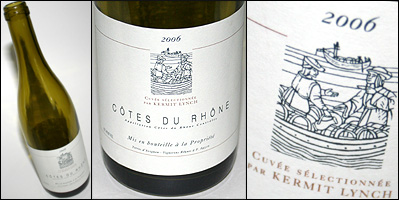
I'm still partial to "old world" wines, though, and if you want to find them in California, the place to go is Kermit Lynch's shop in Berkeley. Sharing a small parking lot with Acme Bread (see Part Two), Lynch's shop screams "wine importer" as loudly as Acme does "artisan bakery". It's essentially a large room with hundreds of stacks of boxes, with the top box of each stack open to display the wines, almost all from France and Italy. My only purchase was a half bottle of Sauternes for a New Year's Eve dinner with friends (this was my first encounter with Sauternes, and I'll say that it's reputation - apparently, the founding fathers were fans - is justified, the words "nectar" and "elixir" coming to mind), but it's hard to go wrong with anything bearing Lynch's "men in a boat" label.
Tuesday, January 26, 2010
Nabokov's Stories
I recently finished reading 650 pages or so of Nabokov's short stories and felt like spewing forth a few thoughts on them, as follows:
Nabokov's stories touch on some perhaps unexpected subjects (angels, astronauts, conjoined twins - that last one isn't really unexpected given VN's obsession with doubles), but in large part he wrote emigre stories for an emigre audience. The bulk of the stories in the most complete collection (The Stories of Vladimir Nabokov) were written in Russian during the period after Nabokov left Russia but before he came to America, and many of them unashamedly depict his nostalgia/longing/sense of loss for the pre-revolutionary Russia of his youth (the content of some of these stories ended up in Speak, Memory). We see a childhood filled with governesses and coachmen, birches and bicycles, and later, a diaspora of nobles and generals carrying their vestigial titles and ranks with them between various European capitals and seaside resorts.
Fascism and totalitarianism appear in more or less recognizable form in many of these stories - memorably in "Cloud, Castle, Lake", where the thuggish brutality of emergent Nazism transforms a train holiday to the country into an absurd Josef K-like nightmare situation where freedom, as represented by the title tableaux, can be glimpsed but not attained. I don't think Lenin or Stalin are ever mentioned by name (except in some of Nabokov's notes on the stories), but they are the unseen villains, the recipients of Nabokov's exquisite ire in stories such as "Tyrants Destroyed".
While the stories are a significant body of fiction, Nabokov is first, foremost, and unquestionably a novelist. It was to the novel that he devoted his greatest efforts and the years of his maturity as a writer, and, to me, the best of his stories are those that most recall the novels. Perhaps the best stories in the collection are "Ultima Thule"/"Solus Rex", a linked pair that are the only surviving chapters of an unfinished novel. They read like (brilliant, somewhat Borgesian) rehearsals for Bend Sinister and Pale Fire (affinities noted by Nabokov in his notes). Based on these two stories, the novel would likely have been a major work had it not become literary kindling.
Reading the stories in chronological order allows the reader to trace the development of the Nabokov's dazzling language play, something he and his son and translator Dmitri clearly took pains to preserve and convey in their English translations. Has anyone done a good, readable study comparing the original texts with the translations? It's common to be curious about the experience of reading a great writer in the original language, but the particular inaccessibility of Russian for most English readers perhaps heightens this feeling with Nabokov, despite the obvious quality of the translations.
By the way, those new covers are not bad, eh?
Nabokov's stories touch on some perhaps unexpected subjects (angels, astronauts, conjoined twins - that last one isn't really unexpected given VN's obsession with doubles), but in large part he wrote emigre stories for an emigre audience. The bulk of the stories in the most complete collection (The Stories of Vladimir Nabokov) were written in Russian during the period after Nabokov left Russia but before he came to America, and many of them unashamedly depict his nostalgia/longing/sense of loss for the pre-revolutionary Russia of his youth (the content of some of these stories ended up in Speak, Memory). We see a childhood filled with governesses and coachmen, birches and bicycles, and later, a diaspora of nobles and generals carrying their vestigial titles and ranks with them between various European capitals and seaside resorts.
Fascism and totalitarianism appear in more or less recognizable form in many of these stories - memorably in "Cloud, Castle, Lake", where the thuggish brutality of emergent Nazism transforms a train holiday to the country into an absurd Josef K-like nightmare situation where freedom, as represented by the title tableaux, can be glimpsed but not attained. I don't think Lenin or Stalin are ever mentioned by name (except in some of Nabokov's notes on the stories), but they are the unseen villains, the recipients of Nabokov's exquisite ire in stories such as "Tyrants Destroyed".
While the stories are a significant body of fiction, Nabokov is first, foremost, and unquestionably a novelist. It was to the novel that he devoted his greatest efforts and the years of his maturity as a writer, and, to me, the best of his stories are those that most recall the novels. Perhaps the best stories in the collection are "Ultima Thule"/"Solus Rex", a linked pair that are the only surviving chapters of an unfinished novel. They read like (brilliant, somewhat Borgesian) rehearsals for Bend Sinister and Pale Fire (affinities noted by Nabokov in his notes). Based on these two stories, the novel would likely have been a major work had it not become literary kindling.
Reading the stories in chronological order allows the reader to trace the development of the Nabokov's dazzling language play, something he and his son and translator Dmitri clearly took pains to preserve and convey in their English translations. Has anyone done a good, readable study comparing the original texts with the translations? It's common to be curious about the experience of reading a great writer in the original language, but the particular inaccessibility of Russian for most English readers perhaps heightens this feeling with Nabokov, despite the obvious quality of the translations.
By the way, those new covers are not bad, eh?
Friday, January 22, 2010
Fred Hersch/Drew Gress/Paul Motian at the Village Vanguard - 1-15-09 Early Set
Having just included both Fred Hersch and Paul Motian in my list of the best live music I saw in 2009, I was surprised to see that they were going to be playing together and curious about how these two very different musicians were going to hook up (bassist Drew Gress has played and recorded extensively with Hersch). One nice thing about Hersch's practice of introducing each tune to the audience is that it makes it possible for someone like me, who's not the best at identifying tunes, to write a more detailed review. I may have the setlist slightly out of order, but I think it's complete.
I Wish I Knew - a not terribly common Harry Warren standard (for what it's worth, the 312th most popular standard, according to jazzstandards.com), taken uptempo. At first, this tune gave me some trepidation about the set to come, as Motian seemed to be overpowering Hersch a bit, threatening to drown him out. As the dynamics evened out part way through, this turned out to be a good showcase for Hersch's extremely fluid improvisations at fast tempos, as well as a kind of warmup piece for the trio. To my ears, a lot of top-shelf pianists can do the sort of thing Hersch was doing on this tune - it's really in other areas (read on) where he blows away the competition.
Still Here - a Hersch-composed tribute to Wayne Shorter, the title also inevitably a reminder that Hersch himself is "still here" and could easily not be after his recent health problems.
Whirl - I think I've heard Hersch play this fairly recent composition (a tribute to dancer Suzanne Farrell) three times now, and it keeps getting better. The distinctive head with its "whirl"ing melodic pattern propels Hersch into the kind of lyrical improvisation at which he's virtually unmatched. He seems committed to never sacrificing his musical or intellectual integrity for the sake of lyricism, never takes the easy route or settles for mere prettiness where real, hard-earned beauty can be had.
Mandevilla - a Hersch bolero, also apparently of recent vintage. He really digs into this one and makes it surprisingly moving - delicate and deep.
Forerunner - Hersch uses this early Ornette tune as a "round robin" showcase for the other members of his trio. I've heard him do it before live and on record, but this version was the finest, most exciting version I've heard. I think Motian's presence is what gave the tune something extra. He was really in his element here, seeming to relish the opportunity to stretch out a bit and making the most of his breaks, each one a little explosion of drum music.
Andrew John - a Gress composition. Hersch seemed eager to do justice to his longtime triomate's tune, a slow-burning beauty with some of Hersch's loveliest playing of the night.
When Your Lover Has Gone - piano trio ballad mastery (click on the link embedded in the title to check out the history of this tune from a forgotten composer of the '20s and '30s, E.A. Swan). My concertgoing companion reported being slightly distracted by Motian's accompaniment on this one (a similar opinion is expressed in this review from later in the run). I was fascinated by his technique on the slower, quieter numbers - scraping the snare head to produce an almost brush-like sound with sticks, but never settling into a set, stock pattern. Even when playing quite minimally, Motian is always changing things up, always creating. [A long digression would be possible here on the evolution of Motian's style through the various phases of his long career, the role he's played in various groups, but I'm not going to attempt it.]
Although the temptation was to focus on Hersch throughout the set, I was rewarded any time I shifted my attention to what Gress and Motian were doing. Motian may have seemed slightly reined in at times, but he found a way to adapt to the context of Hersch's trio without sacrificing his own personality.
Evidence - I knew this trio was going to play some Monk, it was just a question of when. Hersch played a long unaccompanied intro, a flat-out virtuoso moment that was still squarely rooted in the tune and the spirit of Monk. When the bass and drums finally came in, Motian and Gress busted out of the gate to end the set with some thoroughbred trio.
Hersch's touch and tone, which many have commented on, are almost unparalleled, especially when he's playing quietly. He's commented on appreciating the Vanguard for the way the sound from the bandstand fills the room even at low volumes. In that room and at those low volumes, there's something entrancing about his playing. The individual notes can start to register as discreet sensations in a way that I don't think I can describe further without sounding like a Deadhead talking about Jerry's solo on China Cat from Winterland '77. In any case, I think you have to be in the same physical space as the piano for this to happen (or have a much better stereo system than I do). I just picked up Hersch's Live At The Village Vanguard album from 2003, and I'm interested to hear how well it captures the sound of the piano in the room (apparently, it has a reputation as one of the best Live At The Vanguards in terms of sound quality).
I Wish I Knew - a not terribly common Harry Warren standard (for what it's worth, the 312th most popular standard, according to jazzstandards.com), taken uptempo. At first, this tune gave me some trepidation about the set to come, as Motian seemed to be overpowering Hersch a bit, threatening to drown him out. As the dynamics evened out part way through, this turned out to be a good showcase for Hersch's extremely fluid improvisations at fast tempos, as well as a kind of warmup piece for the trio. To my ears, a lot of top-shelf pianists can do the sort of thing Hersch was doing on this tune - it's really in other areas (read on) where he blows away the competition.
Still Here - a Hersch-composed tribute to Wayne Shorter, the title also inevitably a reminder that Hersch himself is "still here" and could easily not be after his recent health problems.
Whirl - I think I've heard Hersch play this fairly recent composition (a tribute to dancer Suzanne Farrell) three times now, and it keeps getting better. The distinctive head with its "whirl"ing melodic pattern propels Hersch into the kind of lyrical improvisation at which he's virtually unmatched. He seems committed to never sacrificing his musical or intellectual integrity for the sake of lyricism, never takes the easy route or settles for mere prettiness where real, hard-earned beauty can be had.
Mandevilla - a Hersch bolero, also apparently of recent vintage. He really digs into this one and makes it surprisingly moving - delicate and deep.
Forerunner - Hersch uses this early Ornette tune as a "round robin" showcase for the other members of his trio. I've heard him do it before live and on record, but this version was the finest, most exciting version I've heard. I think Motian's presence is what gave the tune something extra. He was really in his element here, seeming to relish the opportunity to stretch out a bit and making the most of his breaks, each one a little explosion of drum music.
Andrew John - a Gress composition. Hersch seemed eager to do justice to his longtime triomate's tune, a slow-burning beauty with some of Hersch's loveliest playing of the night.
When Your Lover Has Gone - piano trio ballad mastery (click on the link embedded in the title to check out the history of this tune from a forgotten composer of the '20s and '30s, E.A. Swan). My concertgoing companion reported being slightly distracted by Motian's accompaniment on this one (a similar opinion is expressed in this review from later in the run). I was fascinated by his technique on the slower, quieter numbers - scraping the snare head to produce an almost brush-like sound with sticks, but never settling into a set, stock pattern. Even when playing quite minimally, Motian is always changing things up, always creating. [A long digression would be possible here on the evolution of Motian's style through the various phases of his long career, the role he's played in various groups, but I'm not going to attempt it.]
Although the temptation was to focus on Hersch throughout the set, I was rewarded any time I shifted my attention to what Gress and Motian were doing. Motian may have seemed slightly reined in at times, but he found a way to adapt to the context of Hersch's trio without sacrificing his own personality.
Evidence - I knew this trio was going to play some Monk, it was just a question of when. Hersch played a long unaccompanied intro, a flat-out virtuoso moment that was still squarely rooted in the tune and the spirit of Monk. When the bass and drums finally came in, Motian and Gress busted out of the gate to end the set with some thoroughbred trio.
Hersch's touch and tone, which many have commented on, are almost unparalleled, especially when he's playing quietly. He's commented on appreciating the Vanguard for the way the sound from the bandstand fills the room even at low volumes. In that room and at those low volumes, there's something entrancing about his playing. The individual notes can start to register as discreet sensations in a way that I don't think I can describe further without sounding like a Deadhead talking about Jerry's solo on China Cat from Winterland '77. In any case, I think you have to be in the same physical space as the piano for this to happen (or have a much better stereo system than I do). I just picked up Hersch's Live At The Village Vanguard album from 2003, and I'm interested to hear how well it captures the sound of the piano in the room (apparently, it has a reputation as one of the best Live At The Vanguards in terms of sound quality).
Thursday, January 21, 2010
Dream Journal #5 - The Public Intellectual Who Stole Christmas
In my dream, I was at Christopher Hitchens' house. The place was full of Christmas decorations because he'd been out stealing them from people's front yards. Presumably because he's an atheist. Some people I knew showed up, and I hoped they wouldn't think I was involved with or approved of the theft. Shortly thereafter, the police arrived.
Tuesday, January 19, 2010
Disambiguation Of A Bell
Just saw the news that the founder of Taco Bell has died.
For several years, I was under the impression that Chris Bell, of Big Star and "I Am The Cosmos" fame, was the son of the man who created Taco Bell. I even used to enjoy sharing this bit of false trivia with people, helping to spread my own inadvertently created rock'n'roll "urban legend".
I only recently learned the truth and realized the cause of my confusion. Somewhere along the line, I had taken two pieces of accurate but incomplete information - Bell's father owned a restaurant and Taco Bell was founded by a Mr. Bell - and put them together. In fact, Chris Bell's father was a restaurateur, but his place was called the Knickerbocker. And the founder of Taco Bell was named Bell, but he was from Southern California, not Memphis, and was apparently no relation.
As for Taco Bell, my fondest memory of the place is the time that a high school friend accidentally threw away his retainer along with his greasy taco wrappers and climbed into the dumpster behind the restaurant to retrieve it. I didn't offer to help with the search, but I can only imagine that what he encountered there was just as terrifying as that thing behind the restaurant in Mulholland Drive (I would link to the clip, but I don't want to be responsible for any heartattacks).
For several years, I was under the impression that Chris Bell, of Big Star and "I Am The Cosmos" fame, was the son of the man who created Taco Bell. I even used to enjoy sharing this bit of false trivia with people, helping to spread my own inadvertently created rock'n'roll "urban legend".
I only recently learned the truth and realized the cause of my confusion. Somewhere along the line, I had taken two pieces of accurate but incomplete information - Bell's father owned a restaurant and Taco Bell was founded by a Mr. Bell - and put them together. In fact, Chris Bell's father was a restaurateur, but his place was called the Knickerbocker. And the founder of Taco Bell was named Bell, but he was from Southern California, not Memphis, and was apparently no relation.
As for Taco Bell, my fondest memory of the place is the time that a high school friend accidentally threw away his retainer along with his greasy taco wrappers and climbed into the dumpster behind the restaurant to retrieve it. I didn't offer to help with the search, but I can only imagine that what he encountered there was just as terrifying as that thing behind the restaurant in Mulholland Drive (I would link to the clip, but I don't want to be responsible for any heartattacks).
Monday, January 18, 2010
Notes From The West Coast, Part Two - Food
The second installment of my notes from a recent trip to the SF Bay Area and points north, in which The Selected Ballads tries his hand at food writing. The third and, mercifully, final installment will be stuff I drank.
Acme Bread - Berkeley, CA
I've been describing this place to people as looking like the photos in coffee table books about bread - everything about it is pure, archetypal artisan bakery. This location (the original?) is mostly a working bakery with only a small walk-in sales area, leading to a perpetual line out the door. I tried Acme a few times during my stay in the Bay Area, but on my first visit I was thrown off by the local convention of labeling non-sourdough breads as "sweet" (as in "sweet baguette" rather than just "baguette").
I've eaten a lot of bread in NYC, and I'd say that only Almondine and Sullivan Street are in Acme's league. Unfortunately, I didn't get to find out who else in the Bay Area is in Acme's league - maybe on my next West Coast trip.
Flour + Water - San Francisco, CA
Apparently, this place has had a lot of buzz in SF food circles over the past year, as evidenced by the crowd assembled outside the door 15 or 20 minutes before they opened for dinner. The menu is split evenly between pizza and pasta, with some ambitious appetizers and mains, but I seemed to be one of the few diners who ordered pizza. Maybe pizza as an upscale dinner option hasn't quite caught on in SF the way it has in NYC. In any case, the pizza (size and shape conforming to the lately en vogue Neapolitan style) was quite good, especially the crust, as might be expected from the restaurant's name. (Adam Kuban of Slice was not overly impressed, though he also noticed that most diners didn't seem to be there for the pies.)
What I tasted of my dining companion's pasta was also good - pastas made in-house from unusual ingredients (like beets) seem to be the focus. We also had a lamb's tongue and potato appetizer. I was initially thinking that lamb's tongue might be a green (turns out I was thinking of lamb's ear), but of course it turned out to be exactly what it said it was - the tongue of a lamb - and it was delicious.
Cafe Reyes - Point Reyes Station, CA
I had another good pizza at Cafe Reyes, near Tomales Bay, one of the major spots for oysters on the West Coast. I was slightly disappointed the cafe didn't offer the local specialty, BBQ oysters, but in the end I was happy I ate them raw. I'm not really a great oyster lover, but eating these was an intense sensory experience, tasting so strongly and purely of the ocean that they produced sense-memories of childhood beach vacations (seriously).
Returning to the pizza, I ordered it because it was clear that they took their pizza (a little too?) seriously - prominently displayed peels, wood-burning oven in full view, flour info on the menu. As with Flour + Water, the crust was the highlight, though I may have erred in ordering sausage - the overgenerous portion of crumbled topping caused severe "tip dip" and overwhelmed the sauce and cheese.
El Dorado Kitchen - Sonoma, CA
The trendy boutique hotel vibe of this restaurant was cause for trepidation, but it turned out to be a good experience, with some well thought-out food and old-fashioned good service. Cheese and charcuterie plates were the highlight, each meat and cheese successfully paired with some complimentary flavor (honey, sauerkraut, and prunes were involved, among other things) instead of just being sliced and arranged on a board.
Acme Bread - Berkeley, CA
I've been describing this place to people as looking like the photos in coffee table books about bread - everything about it is pure, archetypal artisan bakery. This location (the original?) is mostly a working bakery with only a small walk-in sales area, leading to a perpetual line out the door. I tried Acme a few times during my stay in the Bay Area, but on my first visit I was thrown off by the local convention of labeling non-sourdough breads as "sweet" (as in "sweet baguette" rather than just "baguette").
I've eaten a lot of bread in NYC, and I'd say that only Almondine and Sullivan Street are in Acme's league. Unfortunately, I didn't get to find out who else in the Bay Area is in Acme's league - maybe on my next West Coast trip.
Flour + Water - San Francisco, CA
Apparently, this place has had a lot of buzz in SF food circles over the past year, as evidenced by the crowd assembled outside the door 15 or 20 minutes before they opened for dinner. The menu is split evenly between pizza and pasta, with some ambitious appetizers and mains, but I seemed to be one of the few diners who ordered pizza. Maybe pizza as an upscale dinner option hasn't quite caught on in SF the way it has in NYC. In any case, the pizza (size and shape conforming to the lately en vogue Neapolitan style) was quite good, especially the crust, as might be expected from the restaurant's name. (Adam Kuban of Slice was not overly impressed, though he also noticed that most diners didn't seem to be there for the pies.)
What I tasted of my dining companion's pasta was also good - pastas made in-house from unusual ingredients (like beets) seem to be the focus. We also had a lamb's tongue and potato appetizer. I was initially thinking that lamb's tongue might be a green (turns out I was thinking of lamb's ear), but of course it turned out to be exactly what it said it was - the tongue of a lamb - and it was delicious.
Cafe Reyes - Point Reyes Station, CA
I had another good pizza at Cafe Reyes, near Tomales Bay, one of the major spots for oysters on the West Coast. I was slightly disappointed the cafe didn't offer the local specialty, BBQ oysters, but in the end I was happy I ate them raw. I'm not really a great oyster lover, but eating these was an intense sensory experience, tasting so strongly and purely of the ocean that they produced sense-memories of childhood beach vacations (seriously).
Returning to the pizza, I ordered it because it was clear that they took their pizza (a little too?) seriously - prominently displayed peels, wood-burning oven in full view, flour info on the menu. As with Flour + Water, the crust was the highlight, though I may have erred in ordering sausage - the overgenerous portion of crumbled topping caused severe "tip dip" and overwhelmed the sauce and cheese.
El Dorado Kitchen - Sonoma, CA
The trendy boutique hotel vibe of this restaurant was cause for trepidation, but it turned out to be a good experience, with some well thought-out food and old-fashioned good service. Cheese and charcuterie plates were the highlight, each meat and cheese successfully paired with some complimentary flavor (honey, sauerkraut, and prunes were involved, among other things) instead of just being sliced and arranged on a board.
Subscribe to:
Posts (Atom)